The width and height of your face, without the myth
Online, a wide face is often called a male trait. A review of earlier studies found little support for that, and it changes how we read this measurement.
By Faciem research · 2026-10-18 · 4 min read
The measurement
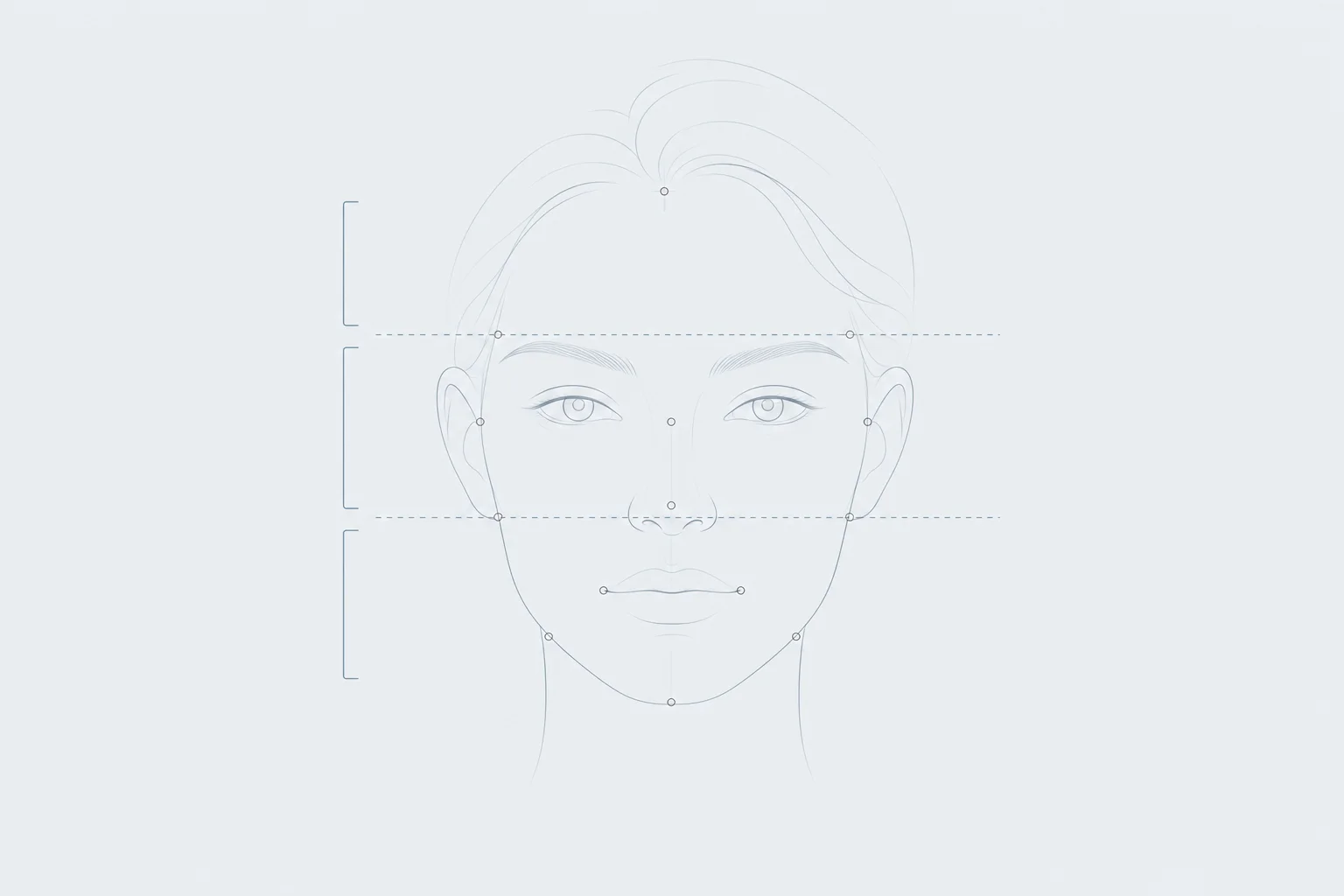
On the tile "Width and height of your face" we set the width of your face, from cheekbone to cheekbone, next to the height from your upper eyelids to your upper lip. In the literature this is called the facial width-to-height ratio. Classically, a face is just under twice as wide as that height (1.9).
What you read online
On forums and in videos, a high ratio is often presented as typically male, as if men and women clearly differ here. In 2017, Robin Kramer looked at whether the research supports that, with a meta-analysis: a study that pools the results of earlier studies.
What the study found
In skulls, the ratio was on average slightly larger in men than in women, but the difference was small. Once the skulls were grouped by origin, a difference remained only in East Asian groups, and that one was small too. In faces, the analysis found little evidence of a difference between men and women: none at all in the white samples, and a medium-sized difference in East Asian groups that, with only three samples, was not statistically certain.
The conclusion: there is no reason to treat the ratio as a measure that sets men and women apart everywhere.
What this means for your report
Your tile says how wide your face is compared with that height, in words and with the number in brackets, and how close you sit to the classical ratio. That is all it says: the number is not a measure of masculinity or femininity, and we do not use it to judge your face. What your protocol says rests on what your photos show, not on this number.
Source
Kramer, R. S. S. (2017). Sexual dimorphism of facial width-to-height ratio in human skulls and faces: A meta-analytical approach. Evolution and Human Behavior, 38(3), 414–420. https://doi.org/10.1016/j.evolhumbehav.2016.12.002
measurements · 4 min read
Is your nose as wide as the space between your eyes?
An old artists' rule says it is. Measurements of hundreds of young adults showed how often that really holds, and why the rule is not an ideal.
measurements · 4 min read
The distance between your pupils and the average face
Just under half the width of your face. A series of experiments from 2010 found that proportion, and it turned out to be the one of an average face.
measurements · 4 min read
What is canthal tilt?
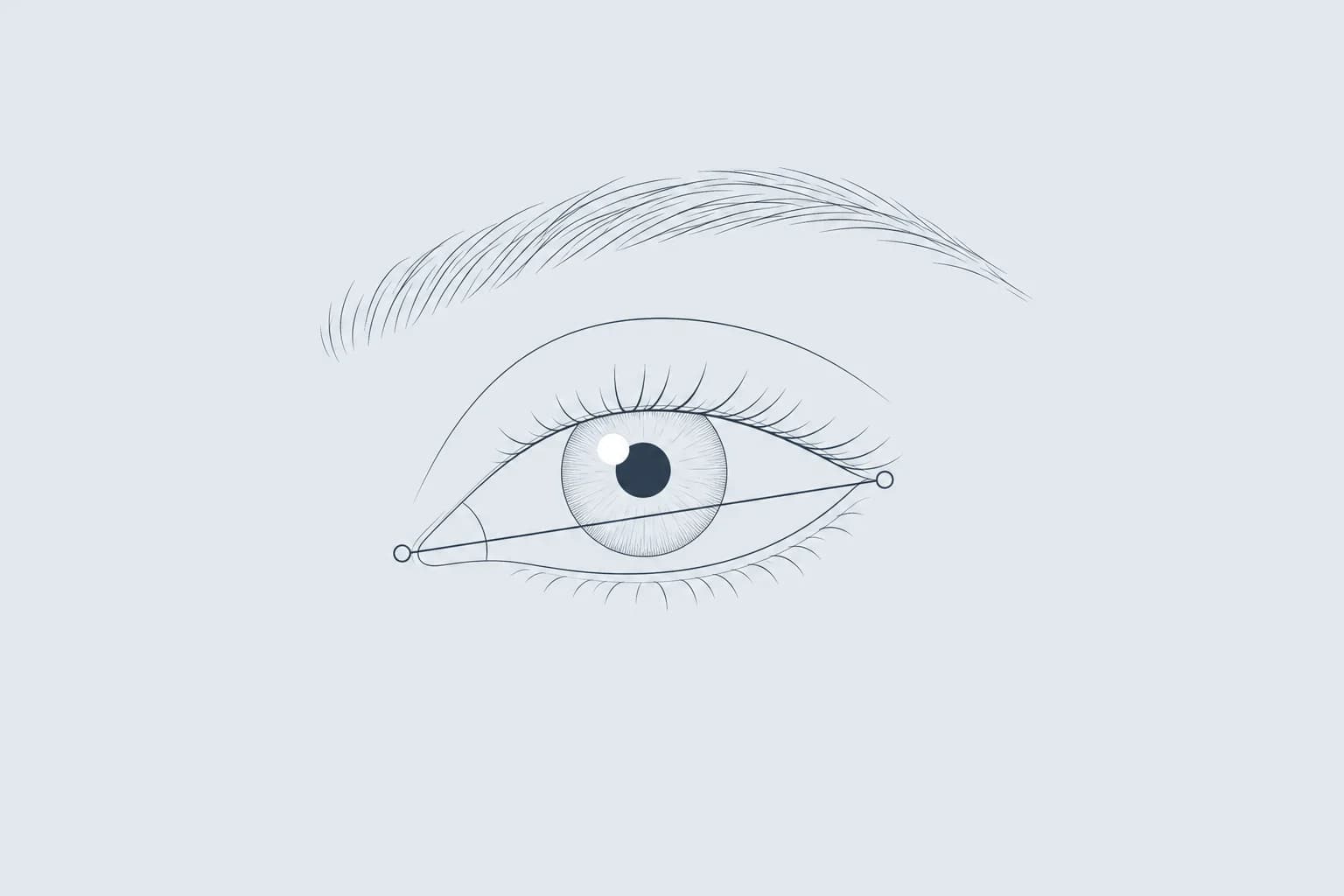
The angle of the line from the inner to the outer corner of the eye, and what a positive or negative tilt does to how the eyes read.