Facial symmetry: an evidence-based guide
What symmetry is, how it is measured, why it matters less than people think, and what actually moves it.
By Faciem research · 2026-09-15 · 7 min read
What symmetry means
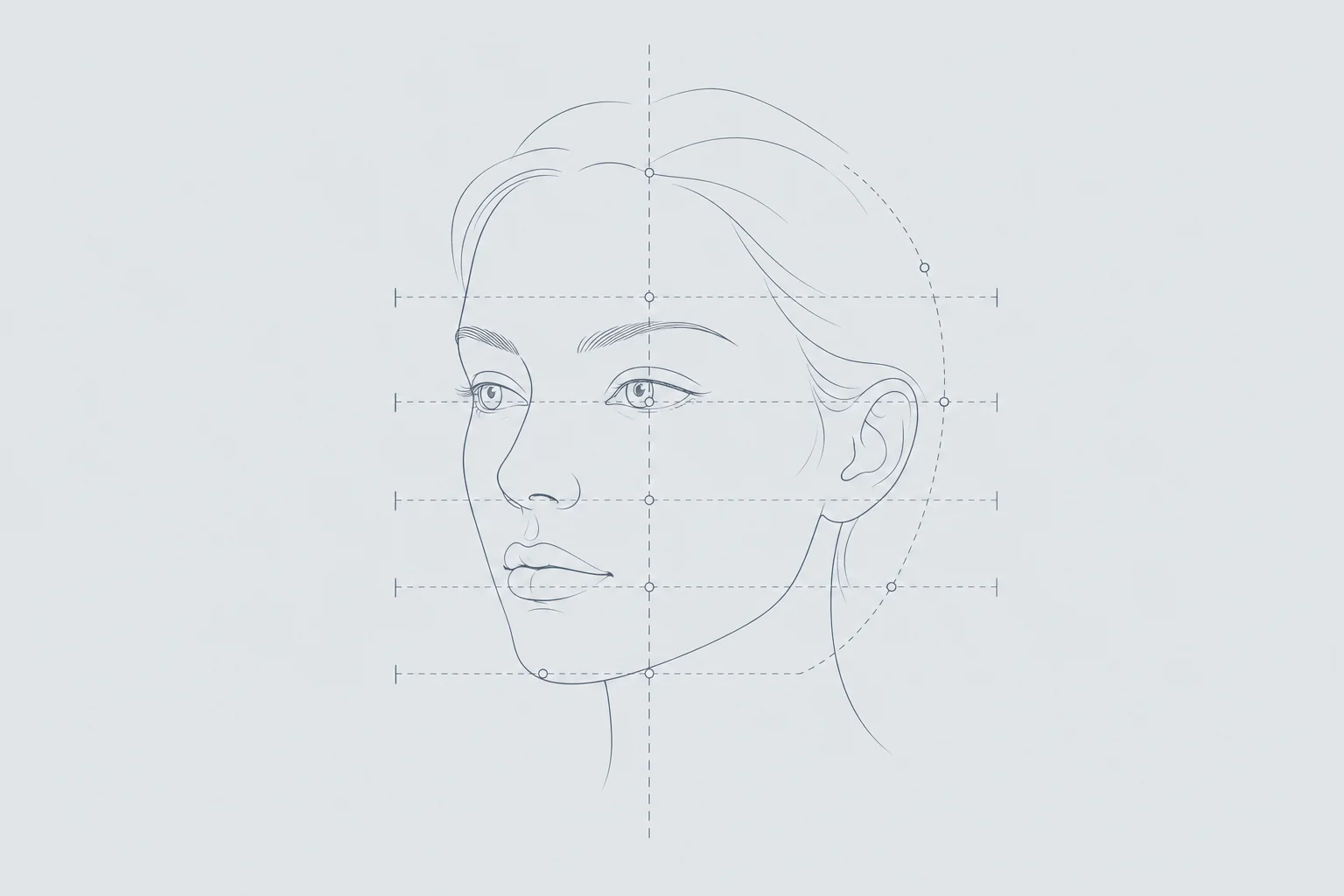
Facial symmetry is the degree to which the left and right halves of the face mirror each other across the vertical midline. Almost nobody is perfectly symmetric, and small asymmetries are read as natural. Large asymmetries, especially around the eyes and mouth, are noticed quickly.
How we measure it
We place landmarks on both sides of the face, mirror one side across the midline, and compute the average distance between corresponding points, normalised to face width. The result is expressed as a percentile within your age, sex and ancestry group.
Example: 78th percentile means more symmetric than 78% of the comparison group.
What the research says
Symmetry predicts attractiveness ratings, but the effect is moderate and much of it is explained by health signals that travel with symmetry: skin evenness, muscle tone and the absence of swelling. Averageness and dimorphism explain more of the variance.
What actually changes it
- Sleeping on your back and reducing sodium reduce morning facial swelling, which is often one-sided.
- Chewing on both sides, and treating dental problems, evens out jaw muscle development over months.
- Posture: a habitual head tilt reads as asymmetry in photos even when the face is symmetric.
- Brow grooming can correct an asymmetry of a few millimetres in minutes.
What we do not recommend
We never recommend surgery to correct symmetry. The visible gain is small and the risk profile is not.
attraction science · 6 min read
Facial averageness: an evidence-based guide
Why faces close to the population average are rated attractive, and why that is not the same as being plain.

attraction science · 8 min read
Facial dimorphism: an evidence-based guide
Masculine and feminine facial traits, what they signal, and why balance beats extremes.